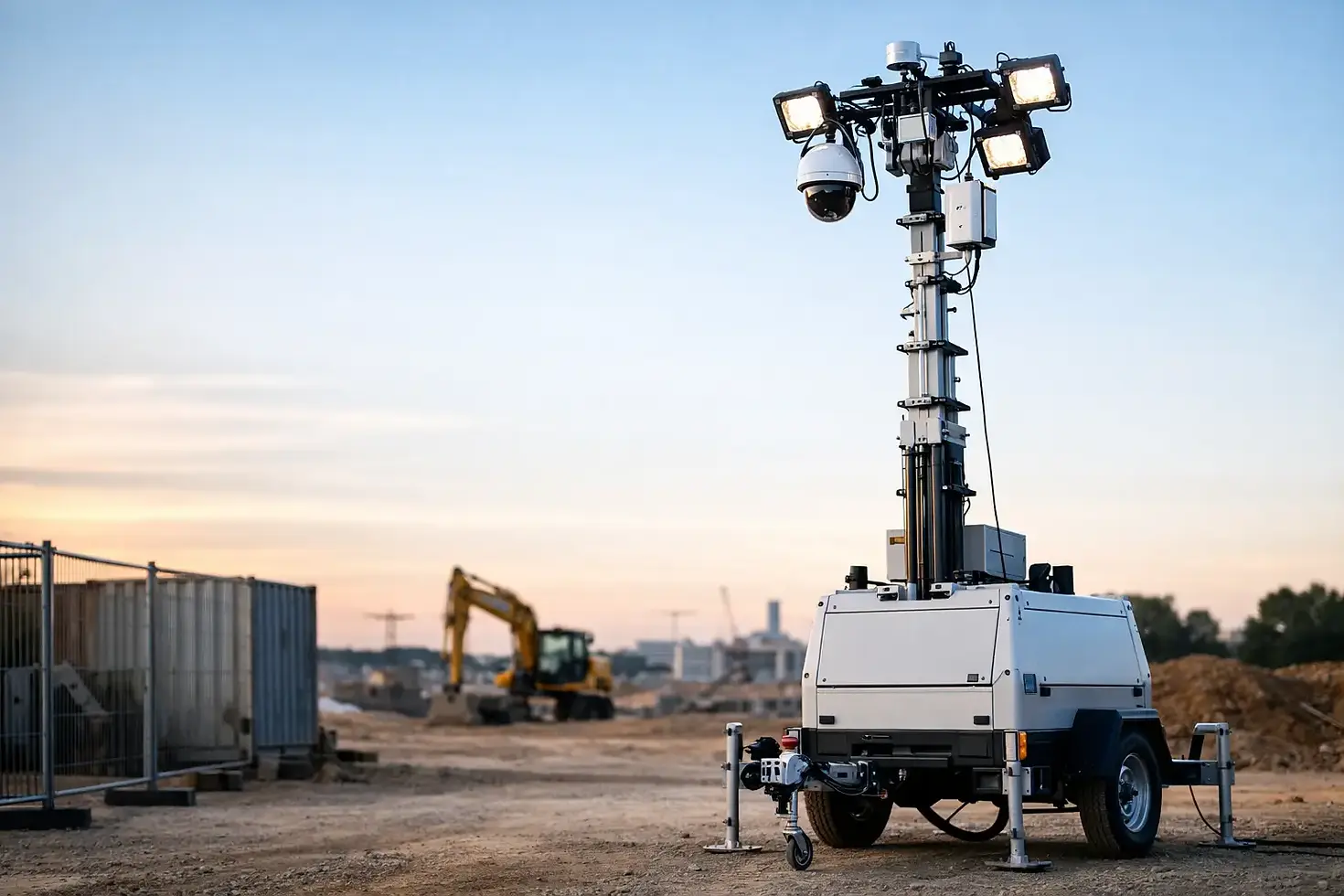
A Practical Guide to Site Security Towers
A stolen skid steer, a cut fence line, or a weekend break-in can set a project back faster than most site managers expect. This guide to site security towers is built for businesses and property owners who need fast, dependable protection for temporary, exposed, or high-risk locations without waiting on permanent infrastructure.
What site security towers are designed to solve
A site security tower is a mobile surveillance unit that brings cameras, recording, power and communications together in one deployable system. In practical terms, it fills the gap when a fixed CCTV installation is too slow, too expensive, or simply not possible for the site.
That matters on construction projects, laydown yards, vacant properties, roadworks, car parks, event spaces and remote compounds. These are the environments where theft, vandalism and unauthorised access tend to happen after hours, and where the lack of power or network connectivity often rules out a standard security setup.
The main advantage is speed. A well-configured tower can be delivered, positioned and commissioned far more quickly than trenching, cabling and installing permanent poles. If site conditions change, the tower can be relocated instead of abandoned.
A practical guide to site security towers for real sites
The right tower starts with the risks on the ground, not the spec sheet. Some sites need broad visual coverage to deter trespassers. Others need clear evidentiary footage at entry points, fuel storage areas, plant compounds or material stacks. If your main problem is after-hours intrusion, live alerts and response options may matter more than simply recording footage.
That is why tower selection should begin with four questions. What are you protecting? When is the risk highest? How large is the area? What happens if an incident is detected? A small residential build in suburban Brisbane will have different requirements from a regional works depot or a commercial site storing high-value equipment.
A tower that looks impressive on paper can still be the wrong fit if the camera placement is poor, the solar capacity is undersized, or the monitoring plan does not match the risk profile. Security works best when the design is tied to the actual operating conditions of the site.
Fixed systems versus mobile towers
There is no single best option for every job. Fixed CCTV is often the right long-term solution for established premises with stable infrastructure, reliable mains power and clear mounting points. It can integrate neatly with access control, alarms and wider building security.
Mobile towers are stronger where flexibility matters. They are particularly useful for temporary projects, leased sites, vacant blocks, infrastructure works and any location where setup time needs to be kept short. They also make sense when the risk moves across the site as works progress.
In some cases, the best answer is a combination. A business may use permanent CCTV at the office or warehouse and deploy a tower to cover overflow storage, a new stage of construction, or a temporary access point.
The core features that matter most
Not all towers offer the same level of performance. Buyers often focus on camera resolution first, but image quality is only one part of the result.
Power supply is critical. Solar-powered systems are ideal for sites without stable mains access, but the design has to suit the local conditions, expected runtime and equipment load. A tower that runs reliably through poor weather is worth far more than one with strong headline specs and weak power management.
Camera coverage also needs careful thought. Wide-angle views help with general oversight, while tighter views are better for identifying people, vehicles and activity near gates or assets. The most effective tower setups usually combine both. Good lighting or low-light performance is also important, especially where incidents occur overnight.
Connectivity matters just as much. If the tower is intended for live viewing, remote access or alarm verification, the communication pathway needs to be dependable. Coverage, signal strength and data handling can affect whether alerts are useful or frustrating.
Then there is the physical structure itself. Mast height, stability, tamper resistance and ease of relocation all affect how well the tower performs on site. A unit that is difficult to reposition or poorly suited to rough ground can become more of a compromise than a solution.
Monitoring, alerts and response
A tower that records footage is valuable. A tower that helps prevent loss before the damage is done is usually more valuable.
This is where monitoring changes the equation. If a system can send verified alerts when someone enters a restricted zone after hours, the response can start immediately rather than after the site manager reviews footage the next morning. That can reduce theft, limit damage and improve the odds of identifying offenders.
Still, live monitoring is not necessary for every site. For lower-risk locations, recorded footage and mobile notifications may be enough. For sites with repeat trespass, expensive plant, copper, fuel or tools, 24-hour monitoring is often justified. The trade-off is cost, but that cost needs to be weighed against likely losses, project delays and insurance headaches.
A practical security plan should define who receives alerts, who has authority to respond, and whether escalation is handled internally or by a professional monitoring service. Technology alone does not create a response plan.
Site conditions can make or break performance
Even a quality tower can underperform if the deployment is rushed. Ground level, line of sight, sun exposure, likely blind spots and nearby obstructions all affect the outcome.
For example, placing a tower where it faces directly into floodlights or rising sun can compromise image clarity at key times. Positioning it behind stacked materials or site sheds can create blind zones that intruders quickly learn to exploit. On busy projects, access routes and storage layouts often change, so the original placement may stop being effective a few weeks later.
This is one reason professional installation and commissioning add real value. The tower needs to be positioned for usable coverage, configured to match the site schedule, and tested under real conditions. False alarms, missed zones and poor visibility are often the result of setup shortcuts rather than equipment failure.
Questions to ask before deployment
Before approving a tower, it is worth confirming how the system will be used day to day. Ask how many camera views are needed, how footage is stored, how long it is retained, how alerts are handled, and what support is available if the site changes.
Also ask what is included operationally. Delivery, setup, relocation, maintenance and site removal can have a direct impact on cost and convenience. A lower upfront price may not stay lower once transport, technician attendance and configuration changes are added back in.
Where site security towers deliver the most value
Towers are particularly effective where risk is concentrated and infrastructure is limited. Construction and civil works are the obvious examples, but they are not the only ones. Vacant commercial land, transport depots, seasonal operations, utility compounds and temporary public-facing sites can all benefit from a deployable surveillance platform.
They also suit transition periods. If a business is waiting for a permanent CCTV upgrade, moving into a new premises, or managing a site after a break-in, a tower can provide immediate coverage while a longer-term plan is developed.
For organisations across South East Queensland, this flexibility matters. Conditions vary from dense urban sites to more exposed regional locations, and a security solution that can be deployed quickly without major site works often makes operational sense.
Buying versus hiring a tower
This depends on how often you will need it and how stable your security requirements are. Hiring usually suits short-term projects, emergency coverage and temporary risk spikes. It keeps capital costs down and allows the system to be removed once the job is complete.
Buying can be the better choice for businesses with recurring site protection needs, ongoing project work, or multiple locations that need rotating coverage. Ownership gives more control over availability and may deliver better value over time, especially if the system forms part of a wider security strategy.
The important point is not to treat the tower as a stand-alone purchase. It is part equipment, part service. Design, installation, configuration and support have a major influence on whether the investment performs as expected.
Choosing a provider, not just a product
If you are comparing options, look beyond the brochure. A capable provider should be able to assess the site, recommend a suitable tower design, install and configure it properly, and support ongoing changes if the project evolves.
That end-to-end approach is especially useful when timelines are tight or the site is complex. Pegasus Data Systems works in this model, combining tower supply with installation, setup, configuration and monitoring options so clients are not left stitching the solution together themselves.
The strongest result usually comes from a tailored deployment, not an off-the-shelf assumption. A tower should fit the exposure, the site layout and the consequence of failure.
A good site security tower does more than watch a space. It gives you a workable way to protect assets, maintain oversight and keep the project moving when permanent infrastructure is not practical. If the setup is right from the start, the tower becomes one less problem to manage and one more control you can rely on.


Comments