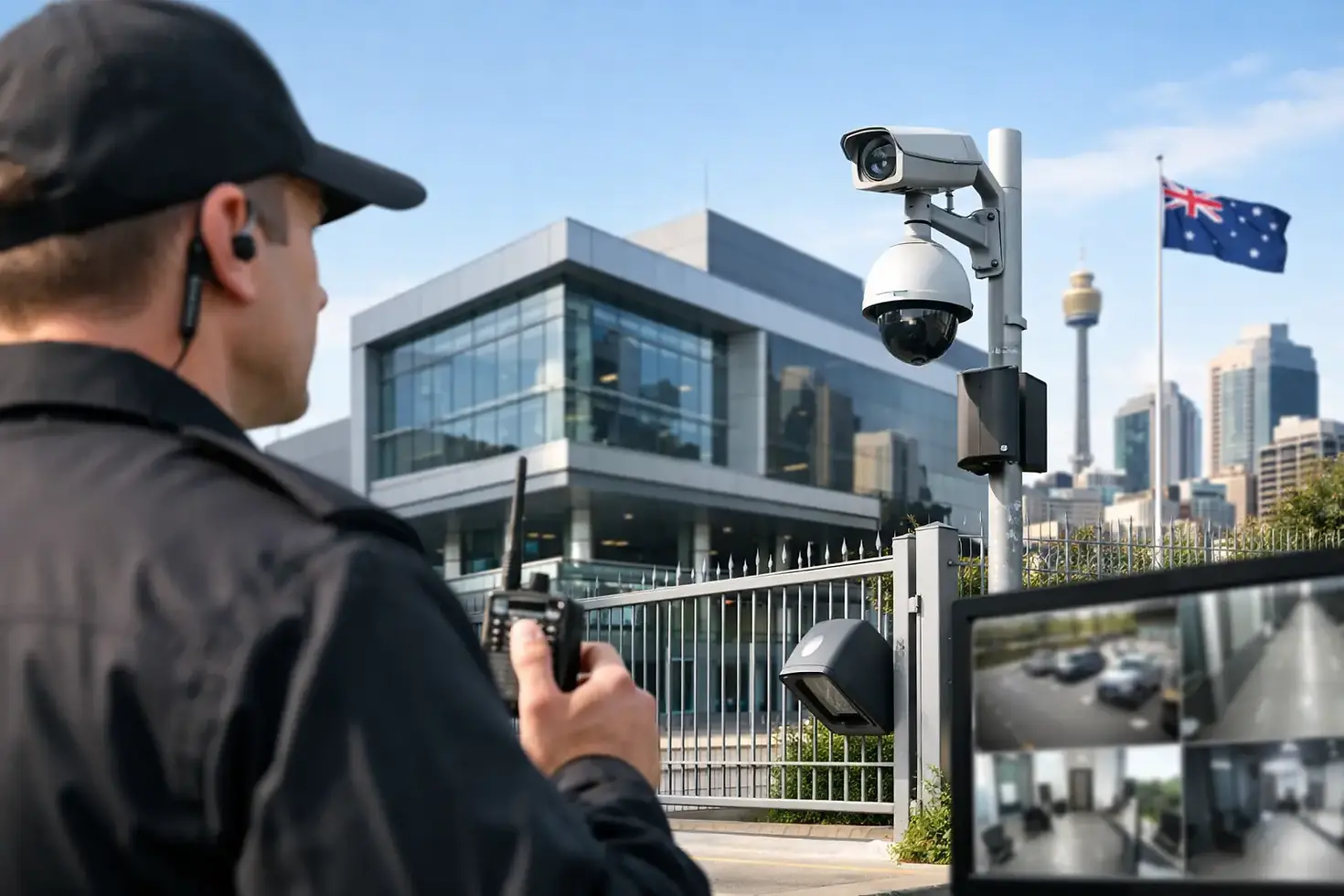
The Future of Commercial Site Security in Australia
A construction site can change more in a week than a fixed security plan can handle in a month. Materials arrive, contractors rotate, fencing moves and high-value plant may sit exposed after hours. The future of commercial site security is therefore not simply more cameras. It is security that can be deployed quickly, adjusted as risk changes and supported by people who can respond when an event occurs.
For commercial property owners, site managers and facility decision-makers, the goal is practical: reduce theft, deter trespass, maintain visibility and keep operations moving. The right system needs to work at a permanent premises as reliably as it does on a temporary or remote site.
Why fixed-only security is no longer enough
Traditional fixed CCTV, alarms and access control remain essential for offices, retail sites, warehouses and established facilities. When they are professionally designed and installed, they provide dependable coverage of entry points, internal areas, car parks and perimeters. The limitation is not the technology itself. It is the assumption that every risk stays in the same place.
Commercial sites are increasingly flexible. A warehouse may expand into an adjoining yard. A civil project may move through several stages. A vacant property may require protection before redevelopment begins. Running new power, communications and cabling to every temporary risk point can add cost and delay, particularly where the site layout will soon change again.
This is where mobile, solar-powered CCTV towers are becoming a core part of commercial protection planning. They provide elevated surveillance and visible deterrence without requiring permanent infrastructure. A tower can be positioned to cover a vulnerable gate, plant compound, materials storage area or boundary, then relocated as the worksite evolves.
The trade-off is that a tower should not be treated as a substitute for every other security measure. Coverage must still be planned around sight lines, lighting, access routes and the value of assets being protected. For many sites, the strongest outcome comes from combining a mobile tower with perimeter controls, alarm detection and a clear response process.
The future of commercial site security is integrated
A camera that records an incident is useful. A system that detects an intrusion, verifies what is happening and prompts an appropriate response is far more valuable. Commercial security is moving towards connected systems that share information rather than operating as separate pieces of equipment.
CCTV will focus on actionable visibility
Higher-resolution CCTV has improved the detail available to operators, but image quality is only one part of an effective system. Camera placement, elevation, field of view, night performance and reliable connectivity determine whether footage can be used when it matters.
Future-ready CCTV systems will increasingly use intelligent analytics to identify events such as people entering restricted zones, vehicles approaching a gate or movement in an area after hours. This can reduce the need to search through hours of footage after an incident. It can also support faster verification before staff, security personnel or emergency services are contacted.
Analytics require sensible configuration. A poorly set system may generate unnecessary alerts from wildlife, rain, moving vegetation or routine contractor activity. Professional commissioning matters because detection rules need to reflect the conditions of the individual site, not a generic factory setting.
Access control will provide a clearer record of movement
Keys are difficult to manage across growing teams, subcontractors and multiple locations. They can be copied, lost or retained after a worker leaves. Electronic access control gives managers more control over who can enter, when they can enter and which areas they can access.
Cards, fobs, PINs and mobile credentials can all suit different operating environments. A small business may need controlled access to a single staff entry, while a larger facility may require separate permissions for offices, server rooms, loading areas and plant rooms. The future is not one credential type for every site. It is a system designed around how people actually move through the premises.
When access events are linked with CCTV, managers can investigate exceptions with more confidence. If a door is opened out of hours, the corresponding camera view can help establish whether it was an authorised arrival, a door left unsecured or an attempted breach.
Alarms and monitoring will prioritise verified response
An alarm remains one of the fastest ways to bring attention to an intrusion. Modern commercial alarm systems can protect doors, windows, internal areas, external zones and higher-risk assets. They can also be tailored with different arming schedules to suit a site that operates extended hours.
The direction of travel is towards alarm events supported by video verification and optional 24-hour monitoring. Rather than relying solely on a notification sent to a busy manager's mobile, a monitored response can assess the alert and follow agreed escalation procedures. This is particularly relevant for unattended sites, remote locations and businesses where the owner cannot reasonably be available every night.
Monitoring is not identical for every customer. The appropriate response plan depends on the location, operational hours, risk profile and budget. It should clearly define who receives notifications, who holds authority to respond and what happens if a threat is confirmed.
Mobile security towers will protect changing and exposed sites
For temporary sites, rapid deployment is becoming a major security advantage. Solar-powered CCTV towers can be delivered and set up without the lead time involved in fixed electrical and data works. Their elevated camera position can provide wide coverage across open areas, making them well suited to construction projects, equipment yards, vacant blocks, events and isolated infrastructure works.
A visible tower also changes the risk calculation for opportunistic offenders. Signage, lighting, cameras and monitoring capability signal that a site is being actively protected. Deterrence cannot guarantee an incident will never occur, but it can make an exposed target less attractive than an unprotected alternative.
The best tower deployment starts with a site assessment. Entry and exit points, blind spots, material storage, plant locations, nearby roads and public access all affect placement. For example, a tower aimed only at expensive machinery may miss the gate used to remove it. A well-designed plan considers the route an intruder is likely to take, not just the asset at the end of it.
In South East Queensland, weather exposure and site conditions also matter. Equipment should be selected and installed for outdoor operation, with dependable power, communications and mounting arrangements. The system must continue providing useful protection through changing work conditions rather than becoming another item for the site manager to maintain.
Cybersecurity and privacy will be part of physical security planning
As cameras, intercoms, alarms and access control become more connected, cyber hygiene becomes part of site protection. Default passwords, unpatched devices and poorly controlled remote access can create avoidable weaknesses. Commercial systems should be configured with secure credentials, controlled user permissions and appropriate network separation where required.
Privacy also needs consideration. CCTV should protect legitimate business areas without unnecessarily capturing neighbouring properties or public spaces. Camera views, retention periods and access to footage should align with the purpose of the system and the organisation's obligations. Clear policies give staff confidence that surveillance is being used responsibly.
These considerations are not reasons to avoid connected security. They are reasons to have systems supplied, installed and configured by technicians who understand both the equipment and the operating environment.
Plan for scale, not just the next incident
A low-cost standalone camera may appear to solve an immediate problem, but it can become expensive when a site grows and each new device needs a separate app, login and maintenance process. A scalable commercial system allows additional cameras, doors, alarm zones and intercom points to be incorporated without rebuilding the whole solution.
Start with the risks that have the greatest operational impact: unauthorised entry, theft of stock or plant, vandalism, after-hours access, staff safety or poor visibility around the perimeter. Then choose a staged plan that addresses those risks now while allowing future expansion.
Pegasus Data Systems designs and installs integrated CCTV, alarms, access control, intercoms and rapid-deployment camera towers for sites that need practical protection without unnecessary complexity. The right solution may be a permanent upgrade, a short-term tower deployment or a combination of both.
Security technology will keep improving, but its value will always depend on thoughtful design, professional installation and a response plan that works after the gates close. A site that can see, detect and respond is better placed to protect its people, assets and continuity of operations.


Comments