
Best Alarms for Small Business in 2026
- pegasusdatasystems
- May 17
- 6 min read
A false alarm at 2 am is frustrating. A real break-in that goes unnoticed until staff arrive at 7 am is far worse. For many owners and site managers, finding the best alarms for small business comes down to one question: what will actually reduce risk at your premises, not just make a noise when something goes wrong?
The answer depends on your site, your hours, your assets and how exposed your business is after dark. A small retail shop in a busy strip has very different risks to a warehouse, trade yard, medical clinic or temporary project site. The right alarm system is rarely just a siren on the wall. It is usually part of a broader protection plan that may include monitored intrusion detection, CCTV, access control and in some cases mobile surveillance towers.
What makes the best alarms for small business?
The best alarm is not always the most expensive one or the one with the longest feature list. It is the system that matches your risk profile and is installed properly. In practical terms, that means reliable detection, clear alerts, minimal false alarms and enough flexibility to protect how your business actually operates.
For a small office, this may be a professionally installed alarm with door contacts, internal motion detectors and mobile notifications for keyholders. For a retailer, it may also need panic buttons, back-of-house detection and integration with CCTV so any event can be verified quickly. For a commercial site with external storage or vulnerable access points, perimeter coverage and monitored cameras may matter more than internal sensors alone.
A good system should also be easy for staff to arm and disarm. If it is confusing, inconvenient or prone to user error, you will see more false activations, more missed arming events and less confidence in the system overall.
The main alarm types small businesses should consider
Most business alarm systems fall into a few broad categories, but the best fit often combines more than one.
Monitored intruder alarms
This is the standard starting point for many small businesses. Sensors detect unauthorised entry or movement, and the system sends an alert either to nominated contacts or to a monitoring centre if that service is included.
For businesses with valuable stock, irregular hours or limited staff presence overnight, monitoring adds a practical layer of response. An audible alarm may scare off some intruders, but a monitored event creates a clearer path to action. That matters if your site is empty, your manager is asleep or your business has multiple locations.
Smart app-based alarm systems
These systems appeal to smaller operators because they are accessible and often cheaper upfront. You can receive alerts on your mobile, check status remotely and arm or disarm the system without being on site.
They can work well in lower-risk environments, but there is a trade-off. Consumer-grade smart alarms are not always ideal for commercial sites with multiple users, complex layouts or higher security exposure. If internet reliability, staff permissions or after-hours verification are concerns, a more professionally configured commercial system is usually the better option.
Integrated alarm and CCTV systems
This is where many businesses get better value. Instead of treating alarms and cameras as separate purchases, the system is designed so an alarm event can be checked against live or recorded video.
That reduces uncertainty and can help filter false alarms from genuine incidents. It also gives owners and managers a clearer picture of what is happening on site before they decide how to respond. For retail, offices, warehouses and mixed-use premises, this is often one of the most practical upgrades.
Site and perimeter alarm solutions
Not every business risk starts at the front door. Storage yards, depots, construction areas and temporary sites often need early detection before someone reaches a building.
In those environments, conventional internal alarms are only part of the answer. External detection, strategically placed CCTV and rapid-deployment tower systems can provide wider site coverage. This is especially relevant where there is no fixed infrastructure, limited lighting or a need for short-term protection.
Key features to look for before you choose
Reliable detection in the right places
Coverage matters more than quantity. A system with ten poorly placed sensors is weaker than one with four sensors installed where entry is most likely. Front entries, rear doors, side access, roller doors and vulnerable internal zones should all be assessed properly.
Pet immunity, glass-break detection and dual-technology sensors can also help in the right setting, but only if they solve a real problem on site. More features do not automatically mean better protection.
Remote access and user management
Most small businesses now expect mobile control, and that is reasonable. Owners want to check whether the system is armed, receive event notifications and manage access without driving to site.
Where several staff need access, user permissions become important. You may want different codes, event logs and the ability to remove access quickly when staffing changes. This is where commercial systems usually outperform basic DIY setups.
Backup power and communication paths
If power fails or the primary internet service drops out, what happens next? That question gets overlooked until there is an incident.
A dependable business alarm should have battery backup and, where appropriate, dual communication options such as IP and mobile network reporting. Redundancy is not a luxury for exposed sites. It is part of making sure the system still works when conditions are less than ideal.
Integration with broader security
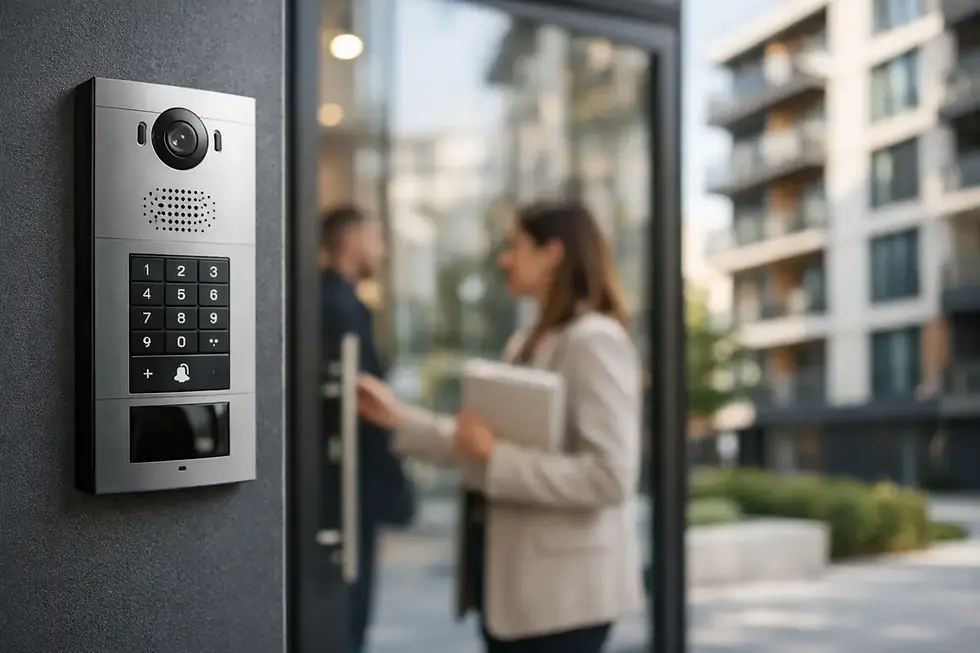
The strongest alarm systems do not work in isolation. CCTV, access control, intercoms and monitoring can all support a faster, more informed response.
If you are already planning camera upgrades or access changes, it often makes sense to design those elements together. That avoids fragmented systems and gives you a more usable result over the long term.
DIY vs professional installation
For a very small tenancy with low risk, a DIY alarm may look attractive on price. The challenge is that hardware cost is only one part of the decision. Placement, configuration, communications setup and staff training all affect whether the system will be trusted when it matters.
Professional installation is generally the better choice for businesses because it reduces blind spots, improves reliability and makes future expansion easier. It also allows the alarm to be tailored around your premises rather than forcing your premises to fit the limitations of a boxed kit.
This matters even more if you need monitored response, camera integration or coverage across warehouses, yards, multiple entry points or temporary locations. A business-grade system should be planned with those realities in mind.
Choosing the best alarms for small business by site type
A café, boutique or convenience store usually needs straightforward intrusion protection, strong rear-entry coverage and camera integration around till areas and stock access. A medical or allied health practice may need the same intrusion protection, but with tighter control over staff access and better internal partitioning after hours.
For offices, the priority is often simple operation, remote management and the ability to separate access levels between staff, contractors and management. Warehouses and workshops usually need broader internal detection, roller-door protection and stronger after-hours verification through CCTV.
For open yards, temporary compounds and high-risk project sites, alarms alone may not provide enough visibility. In these cases, solar-powered CCTV towers, perimeter-aware coverage and optional 24-hour monitoring can be a much stronger fit. That is often the difference between recording a theft after it happens and deterring it before loss occurs.
Common mistakes to avoid
One of the most common mistakes is buying on upfront price alone. Cheap systems can become expensive if they generate false alarms, fail during outages or need replacing within a short period.
Another mistake is underestimating after-hours risk outside the building itself. If tools, stock, plant or vehicles are stored externally, your alarm strategy needs to reflect that. Internal motion detection will not cover an exposed yard or a temporary site boundary.
It is also common to leave security planning too late. Businesses move into a tenancy, open a site or start a project, then treat alarms as an add-on once a problem appears. The better approach is to assess likely entry points, asset exposure and response requirements before installation begins.
What a good alarm decision looks like
A good decision is not about chasing every feature on the market. It is about choosing a system that suits your premises, your hours and your level of risk, then having it installed and configured properly.
That may mean a compact monitored alarm for a suburban office, an integrated alarm and CCTV package for a retailer, or a broader site-protection approach for a commercial yard. For businesses across South East Queensland, the right setup often comes from looking at the whole site, not just the panel on the wall. Pegasus Data Systems works in that space every day, combining alarms with surveillance, access control and rapid-deployment site protection where fixed systems are not enough.
If you are weighing up options, start with the practical question: what are you trying to protect, when is it most vulnerable, and who needs to act when an alarm goes off? The best system is usually the one that answers those three points clearly and keeps doing its job long after installation day.


Comments