Best Intercoms for Apartment Buildings
- pegasusdatasystems
- 22 hours ago
- 7 min read
A resident standing in the lobby with shopping, a courier waiting at the front entry, and a property manager fielding complaints about missed deliveries - that is usually when outdated access systems start costing time and creating risk. The best intercoms for apartment buildings do more than let people speak through a handset. They help control entry, reduce unauthorised access, support residents day to day, and give building managers a more practical way to manage security.
For apartment buildings in South East Queensland, the right system depends on the size of the complex, how many entry points need to be controlled, whether residents want mobile-based access, and how much integration is needed with doors, gates, CCTV, alarms, or access control. There is no single model that suits every site. The better approach is to match the intercom to the building's layout, resident expectations, and security exposure.
What makes the best intercoms for apartment buildings?
In apartment settings, an intercom has to do three jobs well. It needs to verify visitors, make access simple for approved users, and stand up to regular use in shared areas. If one of those pieces is weak, the whole system becomes a frustration rather than an asset.
Reliability matters first. Entry panels, indoor monitors, mobile apps, door strikes, and gate relays all need to work consistently. A low-cost unit may look acceptable on paper, but if audio is poor, video lags, or the directory is awkward to use, residents quickly stop trusting it. That usually leads to people propping doors open, letting unknown visitors tailgate in, or bypassing the system altogether.
Ease of management matters just as much. Apartment buildings often have regular tenant turnover, changing access permissions, and multiple stakeholders including owners, body corporates, and site managers. A system that is hard to update creates admin delays and security gaps. Good intercoms make it straightforward to add residents, remove old credentials, change call routing, and review access events when needed.
Then there is durability. Outdoor entry panels in Queensland conditions need to handle heat, humidity, rain, and constant daily use. Commercial-grade equipment is usually the safer choice for apartment environments because it is built for shared access points rather than light domestic use.
The main types of apartment intercom systems
Audio intercoms
Audio-only intercoms are the simplest option and can still suit smaller apartment blocks with straightforward access needs. They allow a visitor to call a resident, speak with them, and request remote release of a door or gate. They are often less expensive to install than video systems and can be practical for older buildings upgrading from a very basic setup.
The trade-off is obvious. Without video, residents cannot visually confirm who is at the entry. That may be acceptable in a low-risk building with a single secure entrance, but it is less ideal where parcel theft, unauthorised access, or after-hours visitor management are concerns.
Video intercoms
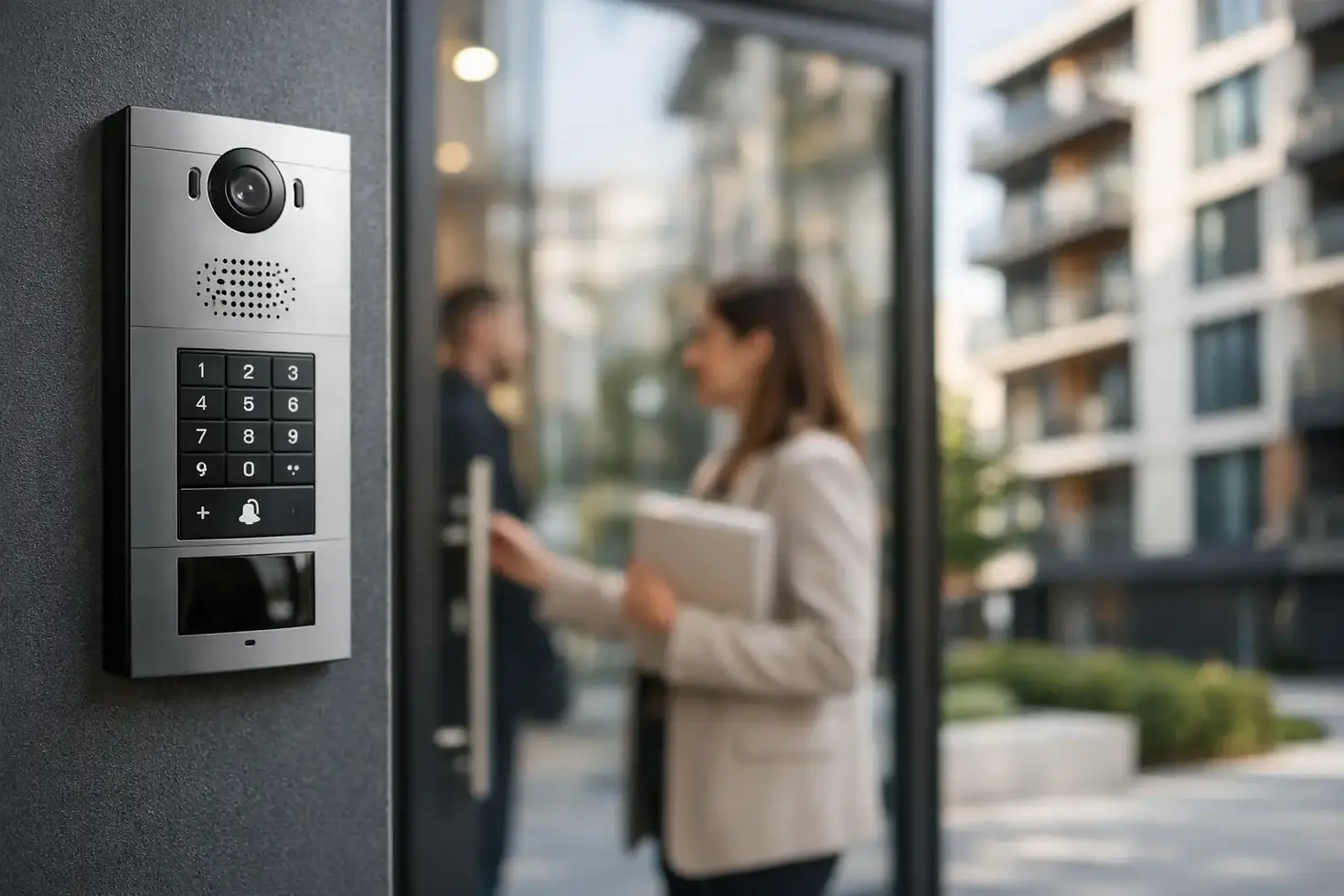
Video intercoms are often the strongest all-round option for apartment buildings because they improve identity checking at the point of entry. Residents can see who is calling before granting access, and managers can set up a more secure and professional front-entry experience.
For many medium and large complexes, video is no longer a luxury feature. It is becoming the baseline expectation. It helps with visitor verification, contractor access, and delivery handling, especially where residents are not always at home but still want confidence around who is requesting entry.
IP and cloud-based intercoms
IP and cloud-managed systems are increasingly popular in apartment buildings because they support remote management and mobile connectivity. Instead of relying only on fixed in-unit handsets, these systems can route calls to a resident's mobile, allow app-based access, and provide easier admin control for property managers.
This can be a strong fit for buildings with frequent tenant changes or owners who want a cleaner way to manage credentials. The trade-off is that these systems need proper network design, stable connectivity, and sensible configuration. If the setup is poor, convenience features can become support headaches.
Hybrid systems
Some sites benefit from a hybrid setup that combines lobby panels, in-unit monitors, mobile answering, fob or card access, and integration with automated gates or lifts. This works well where the building has multiple access points or different user groups, such as residents, cleaners, contractors, and delivery drivers.
Hybrid systems are usually more flexible, but they need careful planning. Without that, the building ends up with overlapping technology that confuses users and increases maintenance costs.
How to choose the best intercoms for apartment buildings
The first question is not which brand is best. It is how the building actually operates. A three-level walk-up with one front entry has very different requirements from a large multi-tower complex with car park gates, shared amenities, and high resident turnover.
Start with entry points. If the site only has one pedestrian door, the solution may be relatively simple. If there are multiple lobbies, vehicle gates, side access points, and service entries, the intercom should be planned as part of a wider access control system rather than as a standalone product.
Resident experience also matters. Some buildings still prefer in-unit monitors because they are familiar and easy for all age groups to use. Others want mobile-based answering so residents can respond to visitors when they are away from the property. Neither is automatically better. It depends on the demographic of the building and how much reliance the site is comfortable placing on apps and mobile devices.
Management workload should not be overlooked. If there is regular leasing activity, you want a system that lets authorised staff update users quickly without calling a technician for every change. On the other hand, some body corporates prefer tighter control and would rather have critical changes handled by a professional installer. That is a valid choice where security is a higher priority than self-service convenience.
Budget is part of the discussion, but it should be framed properly. The cheapest install can become expensive if it causes resident complaints, service callouts, or security breaches. A better comparison is total value over time - equipment quality, installation standard, ease of expansion, and support availability.
Features worth paying for and features that depend
Video verification is usually worth paying for in apartment buildings. It gives residents more confidence and provides a stronger barrier against unknown visitors gaining access. If the building has had issues with tailgating, theft, or nuisance behaviour, video should be high on the list.
Mobile call forwarding can also be valuable, particularly for busy residents and modern developments. It improves convenience and helps with deliveries. That said, it is not ideal for every site. Some buildings still want a dependable indoor station as the primary method, with mobile access as an extra layer rather than the only option.
Access credentials such as fobs, cards, PINs, or mobile credentials should be chosen based on the building's risk profile and user habits. Fobs are familiar and simple, but they can be lost. PINs reduce the need for physical credentials, but they can be shared. Mobile credentials are convenient, but they rely on user adoption and device compatibility. The right answer is often a combination rather than a single method.
Audit trails and event logs are highly useful in shared buildings. They help managers review entry activity, investigate incidents, and maintain clearer control over who accessed specific doors or gates. This is especially relevant in larger complexes or mixed-use buildings.
Integration with CCTV is another feature that can make a real difference. When intercom activity and camera coverage work together, incident review becomes much easier. If someone forces entry, damages a panel, or gains access improperly, you have a stronger record of what occurred.
Installation matters as much as the hardware
A quality intercom can still underperform if it is installed badly. Poor camera angles, weak network design, badly placed panels, inadequate weather protection, and poorly configured door hardware all create problems that residents notice immediately.
For apartment buildings, installation should account for user flow, accessibility, visitor queuing, after-hours lighting, and long-term maintenance. The panel needs to be easy to reach and read. The camera needs a clear line of sight. The door release needs to work with the locking hardware properly. If the intercom is part of a gate or access control upgrade, the full system has to be designed together.
Professional configuration is particularly important with IP and app-based systems. Good setup reduces false call issues, app confusion, and access permission errors. It also leaves the building with a more stable platform for future upgrades.
That is where working with an experienced security provider can save time and prevent rework. Pegasus Data Systems, for example, approaches intercoms as part of the broader site security picture rather than a boxed product dropped into place.
When an upgrade is overdue
If residents regularly complain that they cannot hear visitors, if spare parts are getting difficult to source, or if the building is still relying on a system that cannot support current occupancy needs, the intercom is probably overdue for review. The same applies if there is no practical way to manage user changes, no video verification, or no integration with current access control.
An upgrade does not always mean replacing every component at once. In some buildings, staged upgrades make more sense, especially where existing cabling or door hardware can be retained. In others, a full replacement is the more cost-effective option because patching an ageing system only prolongs the problem.
The best result usually comes from a site-specific assessment rather than choosing a unit based on price alone. Apartment buildings need intercoms that are dependable under daily use, practical to manage, and strong enough to support the level of security the property actually requires. When the system is chosen properly, residents notice the difference straight away - not because it is flashy, but because entry is controlled, communication is clear, and the building feels better protected.



Comments