
Best Cameras for Retail Loss Prevention in 2026
A camera that captures a blurred face at the shop entrance or a dark, unusable image at the register does little to protect your business. The best cameras for retail loss prevention are selected around the way theft actually occurs in your store: who enters, where stock is handled, how transactions are processed and which areas are exposed after hours.
For most retailers, the right answer is not a single camera type. It is a planned CCTV system that combines wide-area coverage, clear identification points, reliable recording and a practical response when an incident occurs. That system should help deter opportunistic theft, support staff safety and provide usable footage when stock discrepancies need investigation.
What makes a retail camera effective?
Retail loss prevention is about more than recording movement. Footage needs to show enough detail to identify people, understand behaviour and establish a clear sequence of events. Camera placement, lighting, lens selection and recording settings all affect that result.
A useful design separates three jobs. Detection shows that someone has entered or moved through an area. Observation lets you monitor what is happening across the shop floor. Identification provides a clear image of a person at key locations such as entrances, service counters and collection points. A camera that is excellent for observation may not be the right unit for identification.
Commercial-grade IP cameras are generally the preferred choice for retail sites because they provide higher resolution, remote access and flexible system expansion. They can also be configured with event alerts, analytics and protected recording, rather than relying on a basic standalone camera kit with limited storage.
Best cameras for retail loss prevention by location
The strongest retail CCTV systems use each camera where it can do the most work. Choosing by location makes the decision clearer than simply selecting the highest megapixel count.
Entrance and exit cameras
Entrances are among the most valuable camera positions in any store. They create a record of who enters and leaves, help staff observe traffic flow and can capture identification-quality images when installed correctly.
A fixed turret or bullet camera with a suitable lens is often effective at an entrance. Look for strong wide dynamic range performance, which helps retain detail when bright daylight sits behind a person entering the shop. Without it, faces can appear as silhouettes. Good low-light performance is also essential for early mornings, late trading and covered entryways.
Placement matters as much as the camera. A unit mounted too high may only record the top of a cap or hood. The aim is to capture a natural face angle while keeping the camera protected from tampering.
Shop floor cameras
For aisles, displays and general customer activity, wide-angle turret, dome or panoramic cameras are practical options. These cameras provide broad visibility across merchandise areas and help managers review events such as concealment, suspicious repeat visits or unattended bags.
A high-resolution fixed camera is often a better choice than an ultra-wide lens where detail is critical. Very wide views cover more space, but people at the edge of the frame may appear too small for useful identification. In larger stores, several correctly positioned cameras normally produce better evidence than one camera trying to cover everything.
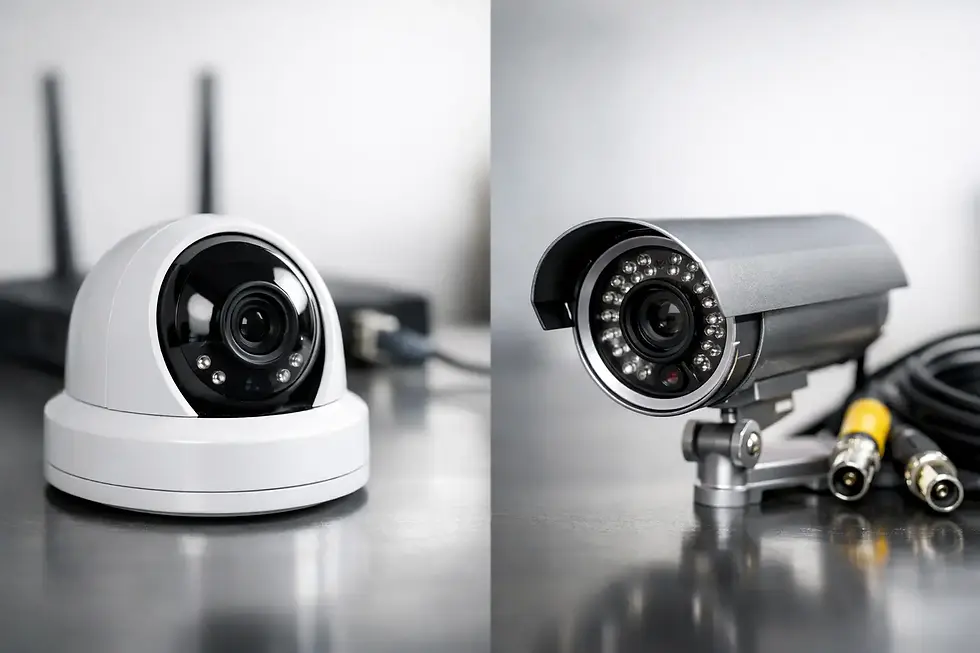
Dome cameras are common on retail ceilings because their compact form suits customer-facing spaces and makes it harder to see exactly where the lens is directed. Turret cameras are also popular because they are straightforward to adjust and generally avoid the infrared reflection issues that can affect some domes in low light.
Point-of-sale cameras
The point of sale needs a dedicated view, not a distant angle from across the shop. A fixed camera positioned to see the counter, operator area and customer interaction can assist with refund disputes, cash handling concerns, fraudulent transactions and allegations involving staff or customers.
The camera should be aligned with your POS processes. It may need to show the till, the counter surface, bagging area and hand movements, while avoiding unnecessary recording of sensitive information such as keypad entries. Professional configuration can also link transaction times with recorded footage, making it faster to locate a specific sale, refund or void.
Stock rooms, receiving areas and staff-only spaces
Stock does not only go missing from the shop floor. Deliveries, returns, waste handling and back-of-house access all create opportunities for loss if processes are unclear or unrecorded.
For stock rooms and loading areas, choose cameras with reliable low-light capability and enough coverage to show cartons, doors and handling zones. A narrow corridor may benefit from a fixed camera aimed down its length, while a busy receiving bay may require multiple views. Access control on stockroom doors can add another useful layer by recording who entered and when.
Cameras in staff areas must be used fairly and lawfully. Avoid placing cameras in bathrooms, change rooms or other private spaces. Staff should understand the workplace surveillance arrangements, and recording should have a genuine security purpose.
Car parks, shopfronts and after-hours areas
External cameras protect the areas where after-hours theft, vandalism and unauthorised access often begin. Weather-rated bullet cameras are well suited to building perimeters, delivery doors and car parks. For large outdoor areas, a pan-tilt-zoom camera can be useful for active monitoring, although it should not replace fixed cameras that maintain constant coverage of key points.
Good external coverage relies on lighting, camera height and a clear line of sight. Infrared can assist in darkness, but it has limits over long distances and in open car parks. Supplementary lighting or specialised low-light cameras may produce more useful colour footage where identification is required.
The features that matter beyond resolution
Resolution is valuable, but it is only one part of an effective loss prevention system. A 4K camera can provide excellent detail, yet it also uses more bandwidth and storage. If the network recorder, hard drive capacity or site internet connection is undersized, high-resolution footage may be difficult to retain or review.
Prioritise wide dynamic range for entrances, infrared or low-light performance for dim areas, and a frame rate that captures natural movement at critical locations. A reliable network video recorder with correctly sized storage is essential. Retailers should decide how long footage needs to be retained based on trading patterns, incident reporting timeframes and their own operational requirements.
Analytics can add value when used carefully. People counting can support store operations, while line crossing, intrusion detection and loitering alerts can flag activity around restricted zones or after-hours entrances. Analytics are most effective when they are configured for the specific site. Generic motion alerts from every passing customer will quickly be ignored.
Remote viewing is another practical feature for owners and managers, but it should be secured with unique passwords, user permissions and properly configured remote access. A camera system intended to reduce risk should not create an easy pathway for unauthorised online access.
Why camera placement beats a bigger specification sheet
The most expensive camera cannot see through a display stand, a promotional sign or a poorly positioned light fitting. Before choosing equipment, walk the store as both a customer and a potential offender would. Identify blind spots near high-value products, sightlines around aisles, unmonitored exits and areas where staff have limited visibility.
Keep cameras visible enough to provide a deterrent, particularly at entrances, counters and external access points. Discreet coverage can have a role in targeted investigations, but it should not be the foundation of a retail security strategy. Clear signage also reinforces that the premises are monitored and helps set expectations for customers and staff.
Consider how the system will be used after an incident. If an owner needs to search hours of footage manually to find a single event, the system is not working as efficiently as it should. Cameras should be named by location, recording times should be accurate and the recorder should be easy for authorised users to access.
Building a system around your store’s real risks
A small boutique with one entry, a counter and compact displays needs a different solution from a large retail tenancy with loading access, multiple exits and high-value stock. Start with the risks that cause the greatest financial or safety impact. This may be shoplifting near particular displays, cash handling at the counter, unauthorised access to stock or vandalism after closing.
A professional site assessment can turn those risks into a camera plan, including field of view, mounting points, cable paths, recorder capacity and remote viewing requirements. It also prevents the common mistake of installing cameras first and discovering later that the critical angle was missed.
For retailers in South East Queensland, Pegasus Data Systems can design and install integrated CCTV, alarms and access control to suit the premises and operating requirements. This is particularly useful where a store needs to upgrade an older recorder, extend coverage to a new stock area or bring several security systems into one manageable setup.
The right retail camera system should make staff feel supported rather than watched, give managers confidence in their evidence and make theft a less attractive option. Begin with the areas where visibility is weakest and loss is most likely, then build coverage that remains useful long after the initial installation.


Comments