
How to Choose CCTV Cameras Properly
A camera that looks good on a spec sheet can still leave you with blind spots at the gate, poor night footage, or images too soft to identify a face or number plate. That is why knowing how to choose CCTV cameras starts with the risk you are trying to control, not the box the camera comes in.
For a home in suburban South East Queensland, that might mean seeing who approaches the front door and covering side access after dark. For a retail shop, it could mean monitoring the till, entry points and stock areas. For a commercial yard or temporary worksite, the priority often shifts to perimeter visibility, after-hours deterrence and dependable monitoring across a larger area. The right answer changes with the environment.
How to choose CCTV cameras for the job at hand
Before looking at lens sizes, recording methods or smart features, define what success looks like. Do you need general awareness, clear identification, or evidence strong enough to review an incident properly? A wide view of a car park may help you track movement, but it will not always capture the detail needed to identify a person at distance.
This is where many buyers come unstuck. They choose one camera type and expect it to solve every problem. In practice, CCTV works best when each camera is selected for a specific purpose. One camera may be ideal for covering a broad frontage, while another is better suited to a narrow side path or roller door.
The first questions are straightforward. What are you protecting? When is the risk highest? Where are the likely entry points? How much area actually needs coverage? Once those answers are clear, the equipment choice becomes much easier.
Start with the site, not the camera catalogue
A small residence and a large commercial site should not be approached the same way. Fixed cameras can work well for homes, offices and stores where infrastructure is already in place. On exposed sites, remote assets yards or temporary projects, a mobile solution may be more practical than running new cabling and power.
For example, if you are securing a construction site, vacant block, event space or civil works area, fixed building-mounted cameras may leave gaps or require more installation than the site justifies. In those cases, rapid-deployment camera towers can make more sense because they provide elevated coverage, visible deterrence and flexibility without relying on permanent infrastructure.
A proper site assessment should consider lighting conditions, access points, fences, car parks, public-facing areas and any place where people can approach unseen. It should also account for practical issues such as available power, network access, mounting positions and whether the site layout is likely to change.
Indoor, outdoor and temporary environments
Indoor cameras generally face fewer environmental pressures, but lighting can still be difficult near windows, roller doors and bright retail entries. Outdoor cameras need to cope with rain, heat, dust and insects. Temporary environments add another layer again, because the system may need to be deployed quickly, repositioned, monitored remotely and removed at the end of the project.
That is why there is no single best CCTV camera. There is only the best fit for the site and the operational requirement.
Image quality matters, but only if it matches the distance
Resolution is one of the first things buyers compare, and for good reason. Better resolution can improve recognition and evidence quality. But more pixels alone do not guarantee a useful image. If the camera is mounted too far from the target area or the lens is too wide, high resolution can still deliver disappointing detail.
A practical way to think about image quality is to separate overview footage from identification footage. Overview footage helps you understand what happened and where someone moved. Identification footage is tight enough to confirm who it was. Most sites need both.
For a front entry or reception area, you may want a camera positioned to capture clear facial detail. For a driveway or loading zone, you may want a different setup designed to read number plates or monitor vehicle movement. If a single camera is expected to cover the whole frontage, the result is often a compromise.
Low-light performance is where weak systems show up
A lot of incidents happen after hours, so night performance deserves close attention. Infrared capability, sensor quality and camera placement all affect the result. A camera with poor low-light handling may show motion, but not enough usable detail to act on.
Lighting conditions also matter more than many people expect. A bright security light in the wrong position can wash out the image. Reflections from glass, polished floors or wet surfaces can reduce clarity. The goal is not just visibility, but consistent footage that remains useful when conditions change.
Choose the right camera type
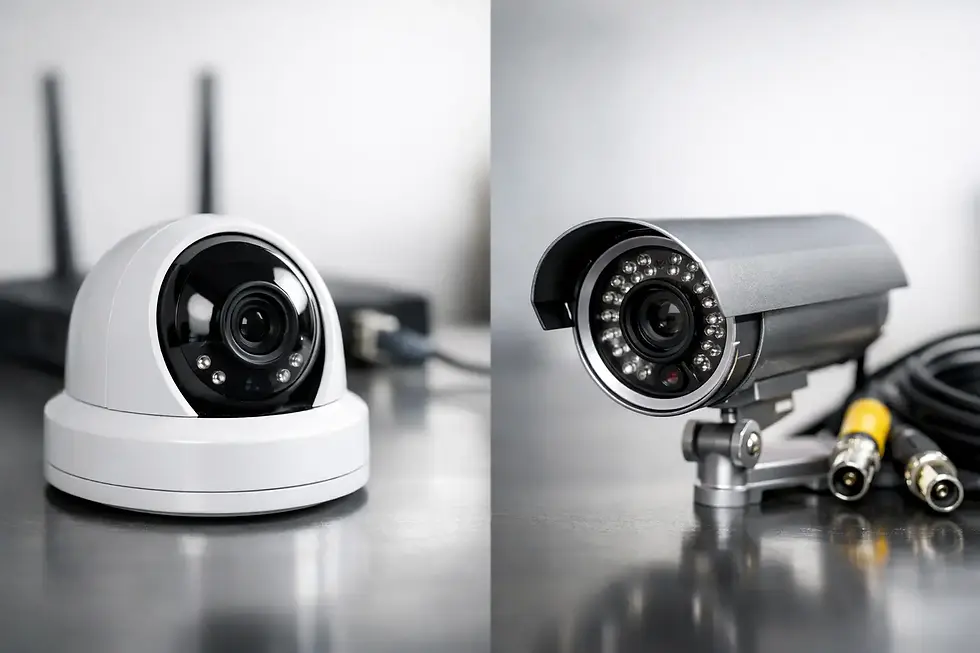
The camera housing and form factor should suit both the environment and the task. Dome cameras are often chosen for internal areas, retail spaces and entries because they are neat, compact and less obvious in their aiming direction. Bullet cameras are common outdoors where a more visible deterrent is useful and longer directional coverage is needed.
Turret cameras have become popular because they often provide strong image quality with fewer infrared reflection issues than some enclosed dome styles. Pan-tilt-zoom cameras can cover large spaces and allow active tracking, but they are not always the best replacement for fixed cameras. If a PTZ is looking one way, it is not watching another. On many sites, fixed coverage still forms the backbone of a reliable system.
For higher-risk or temporary locations, elevated tower-based surveillance can offer a stronger field of view and a more proactive presence. That can be especially valuable where theft, trespass or vandalism risk is high and there is little existing infrastructure.
Think about recording, storage and access
When considering how to choose CCTV cameras, recording is just as important as the cameras themselves. Clear footage is only useful if it is stored properly and easy to retrieve when needed.
Some systems record continuously, while others use motion-based recording or a combination of both. Continuous recording provides a complete timeline but uses more storage. Motion-based recording reduces storage demand, but if detection is not configured correctly, it can miss key moments or create too many false alerts.
Retention time matters as well. A homeowner may be comfortable with a shorter storage window. A business handling incidents, disputes or after-hours access issues may need a longer retention period. The right storage setup depends on how often footage is reviewed, how many cameras are installed, and what obligations apply to the site.
Remote access is another practical consideration. Owners and managers often want to check live footage from a mobile or desktop, especially across multiple locations. That convenience is valuable, but it should be set up securely and with the right permissions.
Smart features are useful, but they are not magic
Modern systems can offer motion alerts, line crossing, person and vehicle detection, and analytics designed to reduce nuisance alarms. These tools can improve response times and make footage easier to review, especially on commercial sites.
Still, smart features need to be matched to the environment. Trees moving in wind, passing traffic, insects around lights and changing shadows can all trigger poor setups. Analytics are helpful when they are configured properly and paired with the right camera positions. They are less helpful when used as a substitute for proper design.
For higher-risk sites, optional professional monitoring can add another layer of protection. It can shorten response times, support incident verification and reduce the burden on site staff or owners who cannot watch alerts around the clock.
Installation quality affects the result more than most people realise
Even good cameras perform badly when they are installed in the wrong place. Mounting height, angle, cable protection, network stability and recorder setup all influence system performance. So does everyday usability. If footage is difficult to export, search or review, the system becomes frustrating when you need it most.
Professional installation also helps avoid common mistakes such as aiming cameras into direct light, setting them too high for facial identification, or leaving key access routes uncovered. On business and site-based projects, it also supports cleaner integration with alarms, access control, intercoms and monitoring services.
That is often the difference between buying cameras and actually improving security. A tailored system is designed around the site, the risk and the response required.
Budget for outcomes, not just hardware
Price matters, but the cheapest option is rarely the most economical if it fails during an incident or needs early replacement. A better approach is to budget around the level of protection required. A small home setup may need only a few well-positioned cameras and reliable recording. A commercial facility or exposed site may need stronger hardware, better night coverage, remote access, analytics and monitoring support.
The trade-off is usually between upfront cost and operational confidence. Spending more where the risk is higher often makes sense. Spending blindly on features you will never use does not.
If you are comparing options, ask what problem each camera solves, what footage quality you can expect at the required distance, how long recordings will be kept, and how the system can scale later. Those answers tell you more than brand labels alone.
The best CCTV setup is the one that fits your site, captures usable evidence and supports a fast response when something goes wrong. If you choose with that standard in mind, you are far more likely to end up with a system that protects people, property and operations when it actually counts.


Comments