
How to Improve Perimeter Security Properly
- pegasusdatasystems
- May 24
- 5 min read
A fence on its own does very little when no one knows who climbed it, which gate was left open, or what happened after hours. If you are working out how to improve perimeter security, the real job is not simply adding barriers. It is creating early detection, controlled access and a clear response plan that fits the risks on your site.
That applies whether you manage a home, a retail premises, a warehouse, a depot, a school, a construction site or an exposed asset yard. The right perimeter setup depends on what you are protecting, how large the site is, how often people come and go, and whether the environment is permanent or temporary.
How to improve perimeter security starts with the perimeter itself
Many properties have weak points that are easy to miss because they are part of the everyday layout. Side access paths, rear car parks, loading areas, service gates, low fencing, blind corners and poorly lit boundaries all create opportunities for unauthorised entry. Before choosing equipment, assess where an intruder would actually approach from and what would make the site easy to target.
A useful perimeter assessment looks at four things. First, can someone enter without being seen? Second, can they move around the site without being challenged? Third, can they reach valuable assets quickly? Fourth, would staff or monitoring personnel know about the breach in time to respond?
This is where many security upgrades go wrong. Businesses often spend heavily on internal cameras or alarms near the building while leaving outer boundaries under-protected. If the first alert comes only after someone has already reached the premises, you have lost valuable time.
Build security in layers, not as a single product
Perimeter security works best when each component supports the next. Fencing or gates create a physical boundary. Lighting improves visibility. CCTV verifies movement and records events. Alarms generate alerts. Access control limits who can enter and when. Monitoring closes the gap between detection and action.
A single device rarely solves the whole problem. A camera without lighting may give poor images at night. A gate without access control can still be propped open. An alarm without monitoring can become background noise. Layering these systems reduces dependence on any one point of failure.
For residential properties, that might mean combining boundary lighting, external CCTV and a monitored alarm. For commercial sites, it often means integrating gates, intercoms, access control credentials, perimeter cameras and after-hours alerting. For temporary or high-risk locations, fixed infrastructure may not be practical, so rapid-deployment surveillance towers can provide coverage where trenching, cabling or permanent poles are not realistic.
CCTV should detect early, not just record later
One of the clearest answers to how to improve perimeter security is better camera placement. Too many systems are installed to watch doors after entry has already occurred rather than to monitor the perimeter where the risk begins.
External cameras should cover likely approaches, gates, fence lines, car parks and areas where assets are stored. The goal is to detect movement before an offender reaches a building, vehicle fleet or storage compound. Camera height, lens choice, lighting conditions and line of sight all matter. If a camera is too high, too wide or pointed into glare, the footage may be of little use.
For larger sites, it is worth separating general overview coverage from identification coverage. A wide-angle camera can show movement across a boundary, while a tighter field of view at entry points helps capture usable facial or vehicle detail. This gives you context and evidence, which are not always the same thing.
Lighting is often the cheapest weak-point fix
Poor lighting makes surveillance harder and gives intruders confidence. Upgrading external lighting around access points, pathways, loading zones and fence lines can improve both live monitoring and recorded footage.
That said, more light is not always better. Harsh floodlighting can create shadowed areas or wash out camera images if it is badly positioned. A properly designed lighting plan should support camera performance rather than work against it. Motion-activated lighting can also be useful in lower-traffic areas, especially when paired with alerts.
Access control matters at the boundary
If people can enter the site freely, perimeter security becomes little more than observation. Gates, doors and vehicle entry points should be controlled according to the way the site operates.
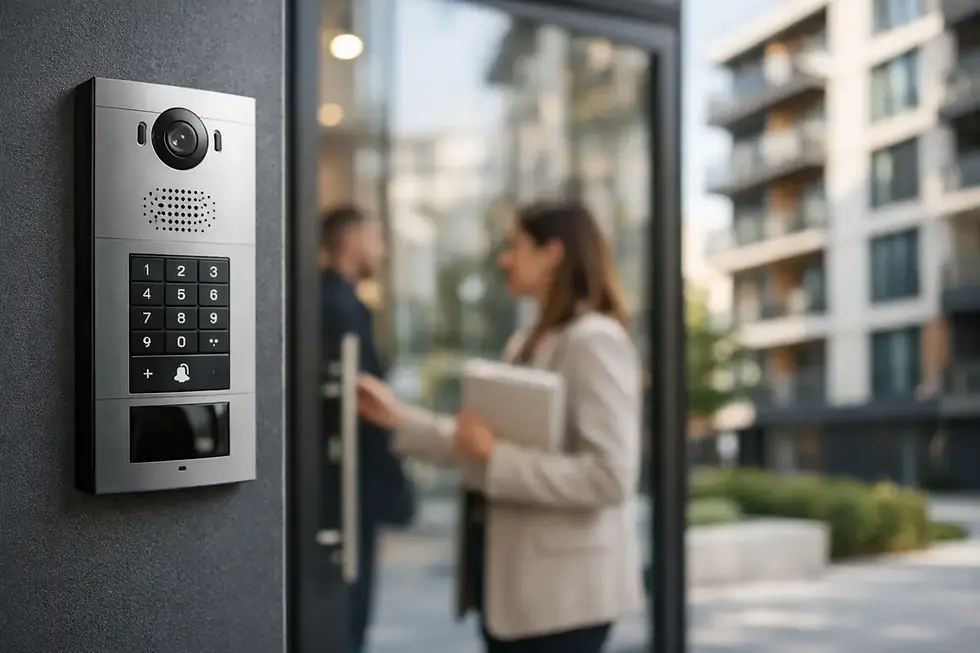
For some premises, a simple keypad or remote gate release may be enough. For busier commercial environments, swipe cards, fobs, mobile credentials or scheduled access permissions provide better accountability. You can see who entered, when they entered and whether access attempts happened outside approved hours. Intercoms also help manage visitors without leaving access points unsecured.
The trade-off is convenience. Tighter access control can slow traffic flow if it is not matched to site operations. Delivery access, contractor access and after-hours callouts all need to be considered so the system remains practical for the people using it.
Alarms and monitoring turn detection into response
Perimeter breaches are not only about recording incidents. They are about responding while the event is happening. That is where alarm integration and monitoring become valuable.
A perimeter camera that detects movement in a restricted zone after hours can trigger an alert. A gate forced open can generate a notification. A monitored system can escalate the event according to the site’s requirements, whether that means notifying keyholders, reviewing footage or following agreed response procedures.
This is especially important for sites that are empty overnight or spread across large areas. Without monitoring, alerts may sit unnoticed until the next morning. With monitoring, there is a much better chance of interrupting theft, vandalism or trespass before losses escalate.
Temporary and exposed sites need a different perimeter strategy
Not every site justifies permanent infrastructure. Construction projects, roadworks compounds, vacant land, temporary storage yards and remote asset locations often need strong protection without fixed cabling or lengthy installation works.
In these cases, mobile surveillance towers can be a practical perimeter solution. Solar-powered towers with CCTV, lighting, alarm capability and optional monitoring can be deployed quickly to cover entry points, open boundaries and high-value equipment. They are particularly useful when the risk is immediate and the site layout may change over time.
The main advantage is speed and flexibility. You can protect a site without waiting for trenching, mains power upgrades or permanent poles. The trade-off is that temporary systems still need proper positioning, maintenance and monitoring settings to perform well. Mobility helps, but only if the deployment is planned around actual risk points.
Maintenance is part of perimeter security
A well-designed system can still underperform if it is not maintained. Cameras go out of alignment. Vegetation blocks sight lines. Gates sag. Intercoms fail. Lighting degrades. Access permissions become outdated. All of these small issues create gaps that are often only noticed after an incident.
Routine checks should confirm that cameras are recording correctly, night vision remains clear, alarms are communicating, gates latch properly and users still have the right level of access. If the site changes, the security design may need to change with it. A new stack of materials, a site office relocation or a rearranged car park can create new blind spots very quickly.
Match the solution to the risk, not just the budget
There is no single answer to how to improve perimeter security because not every property faces the same threats. A suburban home, a retail store and a civil works site all need different levels of deterrence, visibility and control.
What matters is whether the system suits the environment. Smaller sites may only need strategic CCTV, lighting and alarm coverage. Larger commercial properties often need integrated access control and monitored external zones. Temporary or vulnerable locations may benefit most from rapid-deployment camera towers with professional setup and removal handled as part of the service.
The best results usually come from a tailored approach rather than piecing together standalone hardware. When surveillance, alarms, access control and site layout are considered together, perimeter security becomes more than a checklist. It becomes an active part of protecting people, property and operations.
If your boundary is the first place a threat appears, it should also be the first place your security system responds.


Comments