
Best CCTV Options for Warehouses
A warehouse rarely has just one security problem. There is the obvious risk of theft, but there is also after-hours access, blind spots around loading zones, stock shrinkage, vehicle movement, contractor entry, and the simple reality that large sites are difficult to watch well. That is why choosing the best CCTV options for warehouses is less about buying cameras and more about designing coverage that suits the way the site actually operates.
For some facilities, a straightforward fixed CCTV system is enough. For others, especially larger yards, temporary sites, or exposed perimeters, mobile surveillance towers and monitored detection make far more sense. The right answer depends on your layout, operating hours, risk level, and whether you need a permanent installation or a flexible deployment.
What the best CCTV options for warehouses need to solve
A warehouse environment puts more pressure on a CCTV system than a typical office or retail site. Ceiling heights are greater, aisles can be long and narrow, lighting is often uneven, and activity shifts between indoor storage areas and outdoor hardstand. If cameras are chosen on price alone, the result is usually footage that looks acceptable on a small screen but fails when you need to identify a face, read a number plate, or confirm exactly what happened at a loading dock.
The best warehouse systems are built around three outcomes. First, they deter intrusion and opportunistic theft. Second, they provide usable evidence when an incident occurs. Third, they help site managers maintain visibility across operations without creating unnecessary complexity.
That means camera placement matters as much as camera specification. A high-resolution camera mounted in the wrong position still leaves gaps. Likewise, a warehouse with a vulnerable rear boundary or isolated container storage area may need more than internal cameras alone.
Best CCTV options for warehouses by site type
There is no single warehouse CCTV setup that suits every business. A smaller distribution facility with good perimeter fencing will have different requirements from a multi-tenant warehouse, a logistics depot, or a temporary storage yard.
Fixed IP CCTV systems for permanent coverage
For established warehouse facilities, fixed IP CCTV systems are often the foundation. These systems are well suited to internal aisles, receiving areas, dispatch zones, staff entry points, and office interfaces where you need continuous, reliable visibility.
A professionally designed IP system allows cameras to be placed across key operational zones and viewed centrally. You can record continuously, schedule recording by time, or use analytics and event-based triggers depending on the risk profile. This suits warehouses that need dependable day-to-day oversight and a long-term security investment.
The trade-off is that fixed systems rely on available infrastructure. Cabling, network access, power, mounting positions, and recorder capacity all need to be planned properly. For a permanent warehouse, that is usually worthwhile. For a site that changes regularly, it can be less practical.
Turret and dome cameras for internal areas
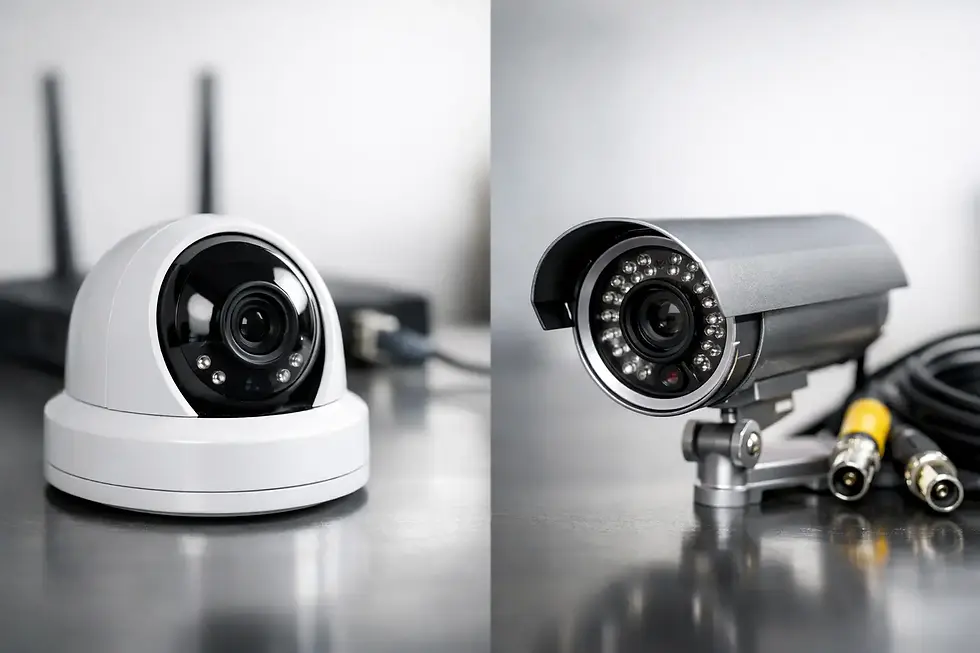
Inside the warehouse itself, turret and dome cameras are usually the most practical option. They work well in aisles, packing stations, access points, and storage zones where you need stable, close-to-medium range coverage.
Turret cameras are often preferred in industrial settings because they can provide strong image quality with less glare or reflection in certain lighting conditions. Dome cameras can be useful where you want a more vandal-resistant form factor or a cleaner appearance in customer-facing areas. In either case, the goal is not to overpopulate the ceiling with cameras, but to position them where they capture movement paths, transaction points, and stock handling activity.
Bullet cameras for perimeters and loading docks
External warehouse areas usually need more targeted surveillance. Bullet cameras are commonly used for loading docks, roller doors, fence lines, car parks, and access roads because they are easy to direct toward a defined field of view.
This matters in places where incidents are most likely to occur - trucks arriving after hours, pallets staged outside, gates left unsecured, or people moving along the perimeter. A well-placed bullet camera can provide better visual verification across these zones than a broader but less focused view.
The main consideration is exposure. Outdoor cameras must cope with weather, dust, heat, and low-light conditions. Warehouses in industrial estates and open yards need equipment selected for that environment, not entry-level hardware intended for domestic use.
PTZ cameras for wide-area supervision
Where a warehouse has large open areas, expansive yards, or multiple traffic points, PTZ cameras can play a useful role. A PTZ camera can pan, tilt, and zoom across a wider area, making it suitable for active monitoring and incident response.
They are especially useful when combined with live monitoring, because an operator can track movement, verify suspicious activity, and zoom in for more detail. On their own, however, PTZ cameras are not a complete solution. Because they can only look in one direction at a time, they should support fixed camera coverage rather than replace it.
This is a common mistake in warehouse security planning. A single PTZ may look impressive on paper, but if it is being used as the only camera over a broad area, you are accepting surveillance gaps.
Mobile CCTV towers for yards, temporary zones, and exposed sites
Some of the best CCTV options for warehouses are not fixed to the building at all. Mobile CCTV towers are a strong fit for warehouse overflow yards, temporary storage compounds, construction-linked warehouse sites, expansion areas, and facilities where rapid deployment is more important than permanent infrastructure.
A tower-based system can deliver elevated coverage, active deterrence, and flexible placement without the delays involved in trenching, cabling, or installing extensive fixed infrastructure. For businesses protecting stock in open hardstand or monitoring vulnerable outer areas, this can be a more practical and faster path to proper coverage.
This approach also suits seasonal operations. If your warehouse footprint changes during peak periods, or you need extra surveillance during a short-term project, a mobile unit gives you flexibility that a fixed system cannot. For high-risk sites, adding optional monitoring creates another layer of protection by turning footage into action rather than just evidence after the fact.
What to look for in a warehouse CCTV setup
Image quality matters, but it is only one part of the decision. Warehouses should be assessed based on how people, vehicles, and goods move through the site. That includes entry and exit points, receiving areas, blind corners, fenced boundaries, and any area where stock sits unattended.
Low-light performance is a major factor. Many warehouse incidents occur after hours, and poor lighting can make average cameras struggle. Storage duration is another practical issue. If you need to investigate a discrepancy discovered days later, short retention periods will not help. Coverage should also account for operational safety, especially where forklifts, delivery vehicles, and pedestrian routes overlap.
Remote access can be valuable for managers who need visibility across multiple sites or after-hours verification. But access should be set up securely and cleanly, not as a patchwork of apps and logins that few staff members can use properly.
Why installation and design matter more than catalogue specs
Warehouse buyers are often presented with long feature lists - resolution, frame rate, analytics, night vision, compression. Those details have their place, but they do not replace a proper site design.
A camera system should be planned around distances, mounting heights, target identification points, and likely incident locations. If a loading dock needs facial recognition-level clarity, that requirement is different from broad overview coverage in a bulk storage area. If the rear yard has no nearby power, a mobile or solar-supported solution may be a better fit than forcing a fixed installation.
This is where an integrated approach is valuable. The best result usually comes from combining the right hardware with professional installation, tailored configuration, and monitoring options where the risk justifies it. Businesses across South East Queensland often need that practical guidance more than they need another generic camera comparison.
Matching the system to the risk
A low-risk warehouse with controlled access and limited after-hours exposure may only need a well-designed fixed CCTV system covering doors, internal movement paths, and the perimeter. A larger facility handling high-value goods may need fixed cameras, PTZ oversight, intrusion detection, and monitored response. A site with remote storage or temporary operations may be better protected by adding a rapidly deployed camera tower alongside permanent building coverage.
The right system is the one that closes your real gaps without adding hardware that does little in practice. Good warehouse CCTV should make the site easier to manage, not harder.
If you are assessing options, start with the problem areas first - where theft could occur, where access is hard to supervise, and where existing visibility breaks down after hours. From there, the best solution usually becomes clear. For many warehouse operators, that means moving beyond basic cameras and investing in a system designed around deterrence, evidence, and dependable site protection from day one.


Comments